

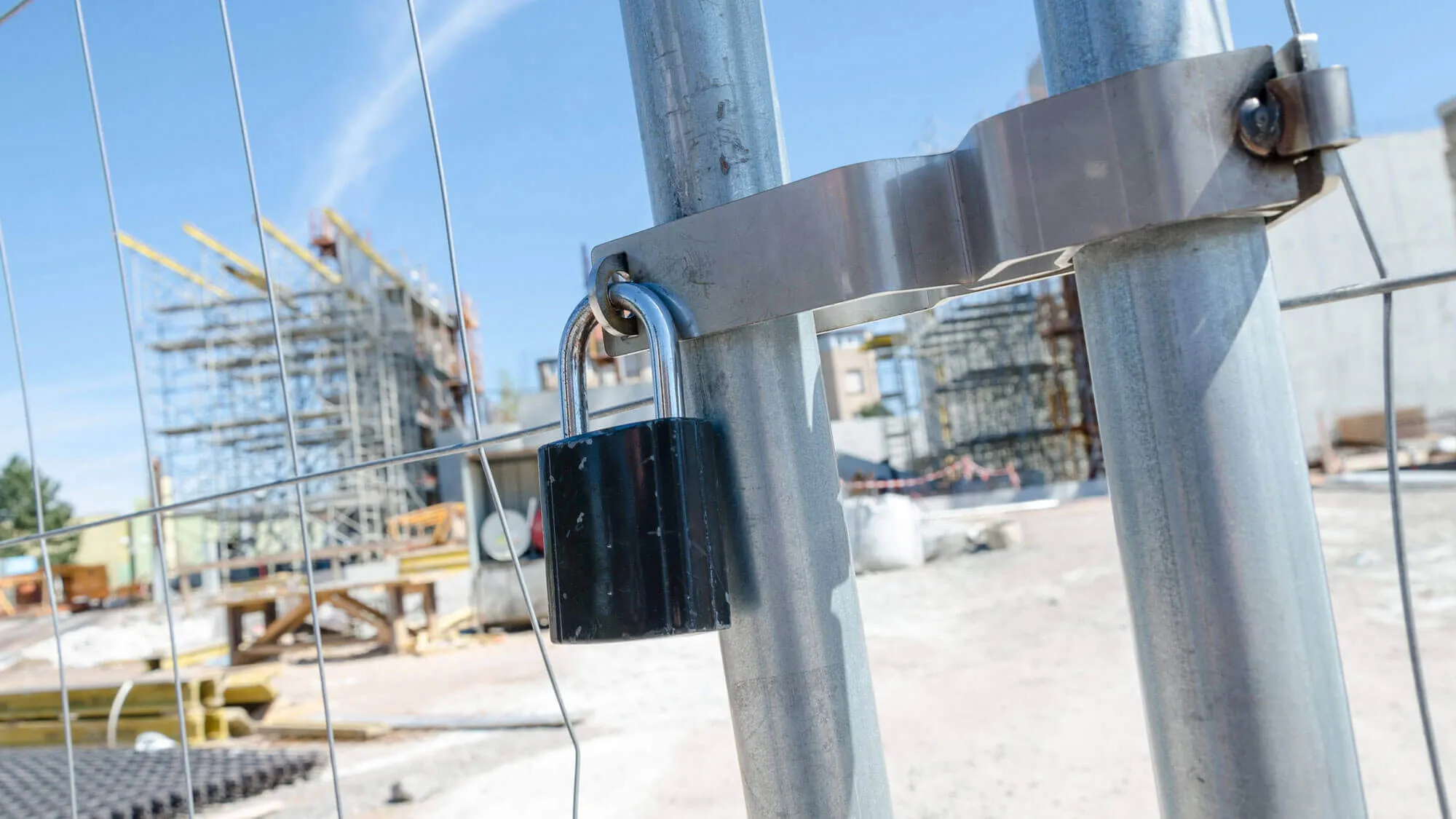
Why Construction Sites Are Targeted More Than Any Other Industry
Retail stores have locked cases, alarm systems, and staff watching the floor. Banks have vaults, cameras, guards, and dye packs. Office buildings have access control, visitor logs, and 24/7 security desks.
Construction sites, by contrast, are large open spaces packed with hundreds of thousands — sometimes millions — of dollars in equipment and materials, sitting largely unattended for 12 or more hours every night and all weekend long.
It is not a coincidence that the construction industry loses an estimated $300 million to $1 billion every year to theft, according to the National Insurance Crime Bureau (NICB) and the National Equipment Register (NER). It is a structural problem, built into the nature of how construction projects work. Understanding why job sites attract criminals is the first step toward doing something about it.
The Scale of the Problem
More than 11,000 construction equipment theft incidents are reported in the United States every year — roughly 1,000 per month — according to the NICB. The NER puts the average cost of a single equipment theft incident at $30,000. And that is only what gets reported. Industry estimates suggest that as many as 85% of construction site thefts go unreported, often because losses fall below insurance deductibles or because contractors absorb the cost rather than deal with the paperwork.
Recovery rates make the picture worse. Only about 20–25% of stolen construction equipment is ever recovered, and for individual tool and small equipment thefts, that number drops below 7%. Compare that to stolen vehicles, which are recovered at far higher rates thanks to standardized VIN systems and well-established law enforcement workflows. Heavy equipment simply does not have an equivalent — serial numbers and PIN schemes are not uniformly recorded, and machines are frequently moved across state lines or exported before a theft is even reported.
The result is a persistent, industry-wide problem that has remained remarkably consistent year after year, suggesting that most of the industry has not yet found an effective way to address it.
Why Construction Sites Are Such Easy Targets
Experienced thieves do not choose targets randomly. They look for environments that offer high value, low risk, and easy access. Construction sites check every box.
Open access with no real perimeter control
Most construction sites have fencing, but fencing alone is not a deterrent — it is an inconvenience. A determined thief with bolt cutters or a flatbed truck can breach a standard chain-link perimeter in seconds. Unlike commercial buildings or retail environments, construction sites rarely have controlled entry points with credentialing systems during off-hours.
Unattended for the majority of every day
A typical construction site is active for roughly 10 hours on a workday. That leaves 14 hours of darkness and vulnerability every night — plus full weekends and holidays. The National Equipment Register has documented consistent spikes in theft around long weekends such as Memorial Day, Labor Day, and Thanksgiving, when sites sit empty for 72 or more consecutive hours and response times are at their longest.
Materials that are nearly impossible to trace
Copper wiring, lumber, steel rebar, and HVAC components are all high-value and essentially untraceable once removed from a site. Lumber prices have increased by more than 300% since 2020, making it an increasingly attractive target. Copper theft alone accounts for an estimated $1 billion in annual losses across all industries, with construction sites as the primary target according to the U.S. Department of Energy. A single truckload of copper wire or framing lumber can yield thousands of dollars on the secondary market with virtually no paper trail.
Little to no surveillance coverage
Only about 13% of construction companies have security cameras on-site, and a significant portion of those are basic systems without remote monitoring, real-time alerting, or adequate night vision. Nearly 60% of construction sites have no security alarm system at all. For a thief doing a quick reconnaissance pass, a site without visible cameras and lighting is effectively an open invitation. By comparison, research consistently shows that sites with visible surveillance coverage are 42% less likely to experience theft.
What Criminals Are Actually After
Understanding what gets stolen helps prioritize where coverage is most critical. Power tools are the most frequently stolen category, accounting for approximately 41% of theft incidents — they are easy to conceal, carry no identifying information, and sell quickly. Hand tools account for roughly 23% of incidents. Small equipment such as skid steers, compact loaders, and generators rounds out the most common targets, with heavy equipment theft being less frequent but significantly higher in loss per incident.
Raw materials follow a similar logic: they are generic, in constant demand, and nearly impossible to identify once they leave the site. Copper is the most valuable per pound. Lumber moves in bulk. Fuel gets siphoned overnight from generators and heavy equipment with no trace left behind.
The BauWatch 2024 Construction Crime Index found that 70% of construction workers witness theft on job sites annually — a figure that underscores how normalized the problem has become on sites without adequate security measures in place.
When Theft Is Most Likely to Happen
Theft follows predictable patterns, and a well-designed security plan can directly address each of them. The large majority of incidents occur after hours and overnight, when sites are empty and law enforcement response times are longest. Weekends account for a disproportionate share of incidents for the same reason. August sees the highest theft rates of any month, correlating with peak construction activity when more assets are on more sites simultaneously.
Project phase matters too. Theft is most common during the early phases of a project, when materials are staged in the open, access controls are least established, and the site layout is still evolving. Rural and remote sites face elevated risk due to limited security presence and fewer bystander witnesses. At the state level, Texas, Georgia, Louisiana, North Carolina, and Florida account for the highest rates of construction equipment theft nationally, according to NICB data.
The Real Cost Goes Beyond the Stolen Item
Replacing stolen equipment is expensive on its own — the NER’s average of $30,000 per equipment theft incident is a substantial hit for any contractor, and many losses fall below insurance deductibles, meaning the contractor absorbs the full cost. But the direct replacement figure is only part of the financial picture.
A single theft incident can trigger project delays of days or weeks, with associated labor costs and potential contract penalties. It creates rental equipment costs to fill the gap while a claim is processed. It can drive insurance premium increases — or loss of coverage altogether after multiple claims. There is administrative burden in the form of police reports, insurance documentation, equipment sourcing, and subcontractor coordination. And there are crew morale and productivity impacts that are difficult to quantify but very real.
When all of these secondary effects are factored in, industry estimates place theft’s total impact at an additional 1–5% of overall project costs. On a $5 million project, that is $50,000 to $250,000 in costs that have nothing to do with building anything.
The Gap Is Closeable
The data is discouraging, but it points clearly in one direction: the construction industry’s theft problem is largely a security investment problem, not an unsolvable one. Sites with visible surveillance are 42% less likely to be targeted. GPS tracking on equipment reduces theft risk by up to 80%. Remote video monitoring with real-time alerting catches intrusions as they happen — not the next morning when the crew arrives and something is already missing.
The gap between what theft costs the industry and what most sites invest in prevention is the core issue. Modern security technology — mobile surveillance units, AI-powered cameras, thermal imaging, 5G-connected monitoring — has made professional-grade site security accessible for projects of almost any size. The sites that do not show up in the NICB’s annual theft statistics are not lucky. They are monitored.
Your Site Does Not Have to Be Part of the Statistics
More than 11,000 reported equipment theft incidents per year. Up to $1 billion in losses. Less than 25% recovery. These numbers describe an industry that has largely treated security as an afterthought — and paid for it accordingly.
If you want to understand what a monitored, site-specific security solution looks like for your next project, contact Site Security Systems. We will assess your site, your timeline, and your risk profile and build a plan designed to keep your project out of next year’s numbers.