

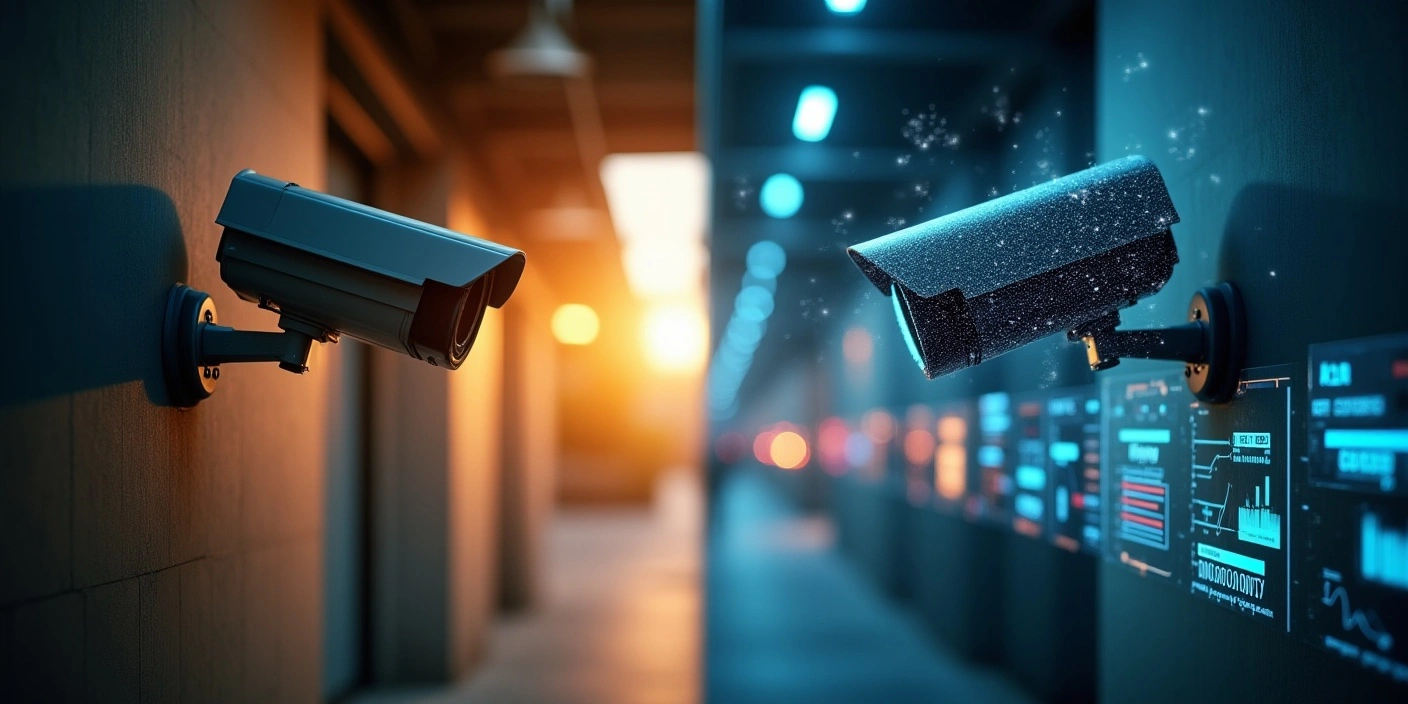
AI Cameras vs. Regular Cameras: What’s the Actual Difference on a Job Site?
Every security vendor is talking about AI cameras right now. The term is everywhere — in brochures, on websites, in sales conversations. And because it is everywhere, it has started to lose meaning. Contractors hear ‘AI camera’ and reasonably wonder: is this a real difference or a marketing label?
It is a real difference. A significant one. But to understand why it matters on a construction site specifically, you need to understand what a regular camera actually does — and where it stops.
What a Regular Camera Does
A standard security camera — even a good one, even a high-resolution one — is fundamentally a recording device. It captures everything in its field of view continuously and stores that footage, either locally or in the cloud. That is its job. It does that job reliably.
What it does not do is think. It cannot distinguish between a worker arriving early and a thief cutting through a fence. It cannot tell the difference between a truck that belongs on-site and one that does not. It captures both identically, stores both identically, and treats both with complete indifference.
The footage a standard camera produces is reactive by design. It is useful after something has happened — for filing a police report, for an insurance claim, for identifying a suspect. It is not useful for preventing the incident in the first place, because nothing is watching the footage in real time. No alert fires. No one responds. The camera records the theft and waits for someone to review it in the morning.
This is not a flaw in the technology. It is what the technology was built to do. The problem is that on a construction site — where incidents happen overnight, on weekends, and in the hours when nobody is present — footage of a completed theft is documentation, not protection.
What an AI Camera Does Differently
An AI camera starts where a regular camera ends. It captures footage the same way — but then it analyzes that footage in real time, continuously, using computer vision models trained to recognize specific types of activity.
Instead of recording everything and treating it equally, an AI camera is constantly asking: does what I am seeing right now match a pattern I should flag? It distinguishes between a car driving past on the street and a vehicle pulling onto the site after hours. Between a worker moving through a well-lit area during the day and a person moving along the perimeter fence at 1 a.m. Between an animal triggering motion in a staging area and a person loading equipment into a truck.
When it detects something that matches a defined alert pattern, it does not store the footage and wait. It triggers an immediate notification — to a monitoring operator, to a security team, to law enforcement dispatch, depending on how the system is configured. The response happens while the incident is still in progress, not after it is over.
This is the core difference. A regular camera tells you what happened. An AI camera tells you what is happening — in time to do something about it.
Why This Matters More on a Construction Site Than Almost Anywhere Else
AI video analytics exist in retail stores, office buildings, parking garages, and dozens of other environments. But the gap between what a regular camera delivers and what an AI camera delivers is wider on a construction site than almost anywhere else — for three specific reasons.
Construction sites are unoccupied for the majority of the day
A retail store has staff present during business hours who can respond to what cameras show in real time. An office building has security personnel watching monitor banks. A construction site empties out every afternoon and stays empty for 14 or more hours. There is no one to watch the footage. An AI camera closes that gap by watching it automatically and triggering a response when it matters.
Construction sites have high false-alarm rates that make manual monitoring impractical
Wind moves tarps and debris. Animals move through open sites. Lights shift. Trees cast moving shadows. On a standard monitored system without AI, each of these triggers a motion alert — and after the twentieth false alarm in a night, monitoring operators stop responding quickly. AI video analytics filter out this noise automatically. The system learns to distinguish a flag snapping in the wind from a person moving deliberately along a fence line. Operators receive alerts that are worth responding to, which means they respond faster and more effectively when a real incident occurs.
Construction sites change constantly
A fixed retail environment looks the same every day. A construction site looks different every week — new structures, repositioned equipment, different crew configurations, evolving sightlines. AI camera systems can be reconfigured as the site changes, defining new alert zones, updating recognition parameters, and adjusting coverage areas without replacing hardware. A standard camera system requires physical repositioning and manual reconfiguration whenever the site layout changes significantly.
Side-by-Side: Regular Camera vs. AI Camera on a Job Site
Capability | Regular Camera | AI Camera |
What it does | Records footage continuously | Records AND analyzes in real time |
Incident detection | None — passive recording only | Automatic — flags defined activity patterns |
Alert speed | After manual review (hours or days) | Immediate — while incident is in progress |
False alarm filtering | None — all motion treated equally | AI filters noise from genuine threats |
Night performance | Depends on lighting | Thermal + AI works in complete darkness |
Response enabled | Reactive (post-incident) | Proactive (during incident) |
Site change adaptation | Manual repositioning required | Alert zones reconfigured digitally |
Value to insurance | Documents loss after the fact | May reduce premiums as active deterrent |
The Question That Actually Matters: Documented or Prevented?
When a GC or project manager evaluates security cameras, the instinct is often to compare resolution, storage capacity, and price per unit. Those are legitimate considerations. But they are secondary to a more fundamental question: do you want footage of what happened, or do you want to stop it from happening?
A regular camera, even a very good one, answers the first question. It will give you clear footage of the theft. It will show you the faces, the vehicle, the timeline. It will help you file a police report and an insurance claim. It will not give you the equipment back. It will not un-delay your schedule. It will not undo the conversation with the GC about the schedule impact.
An AI camera — integrated with a monitored response system — answers the second question. When an alert fires at 1:47 a.m. on a Sunday and a monitoring operator issues an audio warning through the on-site speaker, the person on your site has a choice: leave immediately, or risk law enforcement arriving while they are still there. Most leave. The equipment stays.
That is the difference the technology makes in practice. Not on a spec sheet — on your site, on the Monday morning when you pull up and everything is where you left it.
What to Ask When Evaluating a Camera System
If you are assessing security options for an upcoming project, these are the questions that will tell you whether you are looking at documented or prevented:
- Is the footage monitored in real time, or is it reviewed after an alert or incident?
- What does the system do when it detects unauthorized activity — who gets notified, how fast, and what is the response protocol?
- How does the system filter false alarms specific to construction environments — wind, animals, crew movement during authorized hours?
- Can alert zones be reconfigured as the site layout changes between project phases?
- What happens after hours and on weekends — is monitoring coverage consistent or reduced?
- Does the system integrate thermal imaging for overnight and low-light coverage?
The answers to those questions will tell you more about the real-world value of a security system than any specification sheet will.
AI Is Not a Buzzword in This Context — It Is the Mechanism
In a lot of industries, AI is a label that gets attached to products to make them sound more advanced than they are. In construction site security, it describes a specific and meaningful capability: the ability to analyze what a camera sees in real time, distinguish genuine threats from background noise, and trigger a response while an incident is still in progress.
That capability closes the gap that has made construction sites a persistent theft target for decades — the gap between when something happens and when someone finds out about it. On a site that empties out every afternoon, that gap has historically been twelve hours or more. With AI-powered monitoring, it can be measured in seconds.
If you want to understand what an AI-powered monitoring system looks like deployed on a construction site — what it covers, how it responds, and what it costs relative to a standard camera setup — contact Site Security Systems. We will walk you through exactly what the technology does and build a coverage plan for your specific site.